


The Vote Is In — Prop 50 Passed. Now What for Oakland?
California may redraw its maps — but until you and I demand those maps trigger real change in real time, we’re just playing by someone else’s rules. People here deserve better than being represented only in Washington while being forgotten in their own community.
Because if they won’t put The Town first, we will. It’s time to Rethink Oakland.

BY: THE RETHINK OAKLAND TEAM
- California can redraw its lines. Oakland still needs to redraw its future.
Politics/Reaction
Late night on November 4, 2025, California voters approved Proposition 50: the constitutional amendment that hands the state Legislature the power to redraw congressional districts, temporarily setting aside the independent commission, and ultimately: It passed convincingly. For many, it was a win — a political rebuke of gerrymandering elsewhere and a show of strength against conservative states. For many Oaklanders assembled around kitchen tables, corner stores, and bus stops, it felt like just another move on a chessboard that never includes them.
The official line behind Prop 50 was framed as protecting democracy — specifically, making sure California could respond if states like Texas redraw lines in deeply partisan ways. Supporters argued it ensures representation and safeguards California’s voice and power in Congress.
But for Oakland, the timing and focus raise important questions: What about representation at home? What about safe neighborhoods, productive business corridors, quality education, and affordable housing? Those issues remain real and immediate.
The problem is, changing the shape of districts state-wide or even nation-wide doesn’t automatically change the shape of our daily lives in Oakland.
Let’s be clear — I’m not dismissing the reality that maps matter in Washington. But maps matter far less when the map’s contents live in disorder. You can redraw lines on a map, but you can’t redraw boarded-up storefronts, uncertain walkways, stolen inventory, or fear of letting your kid ride the bus alone.
Prop 50 is about power. Who draws the lines? Who wins the seats? It’s not about how many working-class Oaklanders get relief from persistent harm.
And that leads to the deeper issue: Leadership. Because if district boundaries are the only lever being pulled, while the real hardware of governance (policing, code enforcement, small-business support, community investment) remains broken, then the vote is symbolic at best, superficial at worst.
Governor Gavin Newsom championed Proposition 50 as part of a broader campaign against national — specifically Republican — opposition. He cast the vote as a bulwark against Donald Trump-style politics. That framing served a national audience, not necessarily the people of Oakland.
While Sacramento celebrates a victory that all but guarantees Democrats five additional congressional seats, back here in Oakland, the Town still grapples with rising crime, shuttered storefronts, soaring rents, unreliable transit, and unsafe neighborhoods.
Representative Lateefah Simon, Oakland’s newly elected member of Congress, has become emblematic of a larger problem: too many Bay Area leaders seem to take their cues from Sacramento and Washington rather than from the people who live here. Her priorities mirror those of state and national party figures, not the neighborhoods that elected her. When our representatives focus on pleasing political networks instead of solving local problems, Oakland ends up as an afterthought: applauded in speeches, yet ignored in action.
Let’s imagine the best-case scenario under Prop 50: California gains five additional Democratic-leaning congressional seats, the national media cheers, and our state’s voice in Congress gets a little louder. Fine. But meanwhile…
On Hegenberger Road in East Oakland, dozens of storefronts remain gated and vacant, and patrol cars are few and far between.
In West Oakland’s Lower Bottoms, residents still wait too long for emergency response — sometimes watching crises unfold before help arrives.
Across Fruitvale and San AntoniO, single parents juggle two jobs and still struggle to find affordable after-school programs as funding stalls.
And in Downtown and Uptown, small business owners continue closing early, or even closing completely — not from lack of customers, but from fear of another smash-and-grab.
The real focus needs to be here. Sacramento’s redistricting fight does nothing to reset enforcement budgets, reduce response times, restore trust in government, or fix homes. The people of Oakland are still living on the same broken foundation —but only now with different map lines!
So what do we do? Because the vote has happened and now the work begins:
1. Demand transparency in spending and outcomes
If your district is re-lined, that’s your community. Ask: What new resources did that bring? Did our funding improve? Did enforcement improve? Did housing affordability shift? If not, demand it.
2. Track the promised seats and power shift
Prop 50’s architects expect to pick up five seats and flip the calculus for the U.S. House. But more seats won’t guarantee results. Oaklanders should vote with success in mind — not victory in a press release.
3. Keep local officials grounded in local reality
Vote with data. Hold your local representative accountable for what happens in your block, your bus route, your storefront corridor. Not what they say nationally.
4. Build a local platform for results
Sacramento sets the policies, but Oakland lives the execution. Make sure your neighborhoods ask: What commitments were made for us? What guarantees are there? How will we measure them?
It’s tempting to dismiss everyone who voted yes on Prop 50 as part of the “elite left.” But in the end, that’s not useful. Many of those voters were acting with good faith, trying to push back against what they deemed as an unfair realignment that happened elsewhere in the country. The challenge now is to bring that same vigor and passion to combatting real issues in The Town. Because the same compassion that pushed them to vote yes must now be steered toward street-level results: safer sidewalks, vibrant businesses, clean parks.
We should guard against one kind of tribalism: assuming our allies are only those who share national labels. The fight here is much narrower and deeper; it’s about watching whether leaders put Oakland first. Does the logic of their policies start here, or does it end there?
Prop 50 passing doesn’t mean the fight is over. It means the stakes shift. Now the real work begins at home.
California may redraw its maps — but until you and I demand those maps trigger real change in real time, we’re just playing by someone else’s rules. People here deserve better than being represented only in Washington while being forgotten in their own community.
Because if they won’t put The Town first, we will. It’s time to Rethink Oakland.
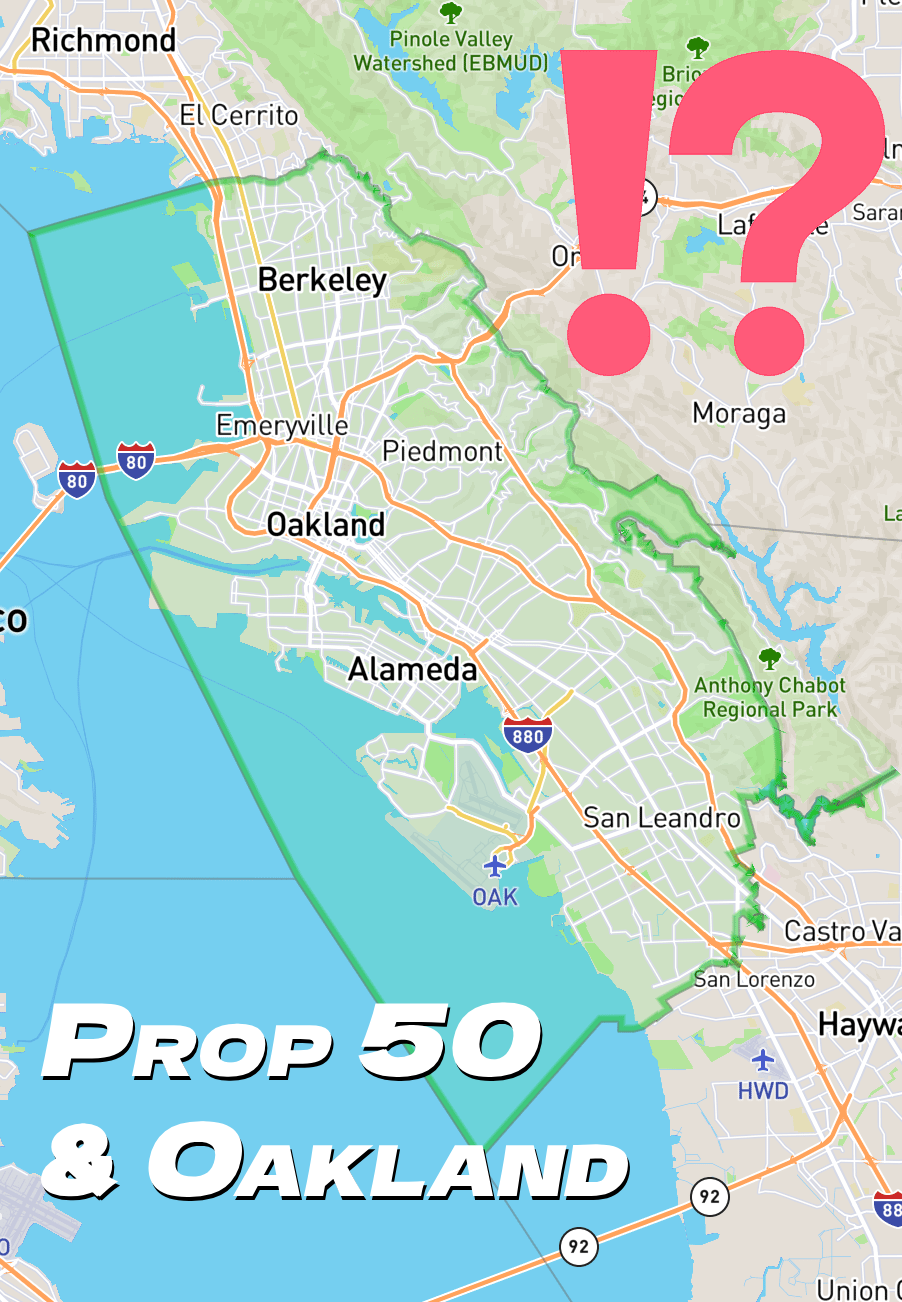
Proposition 50 Won’t Fix Oakland — Because Our Problems Aren’t on a Map
Prop 50 is being sold as a defense of democracy. In reality, it’s another distraction from the chaos and decline California’s leaders refuse to confront.
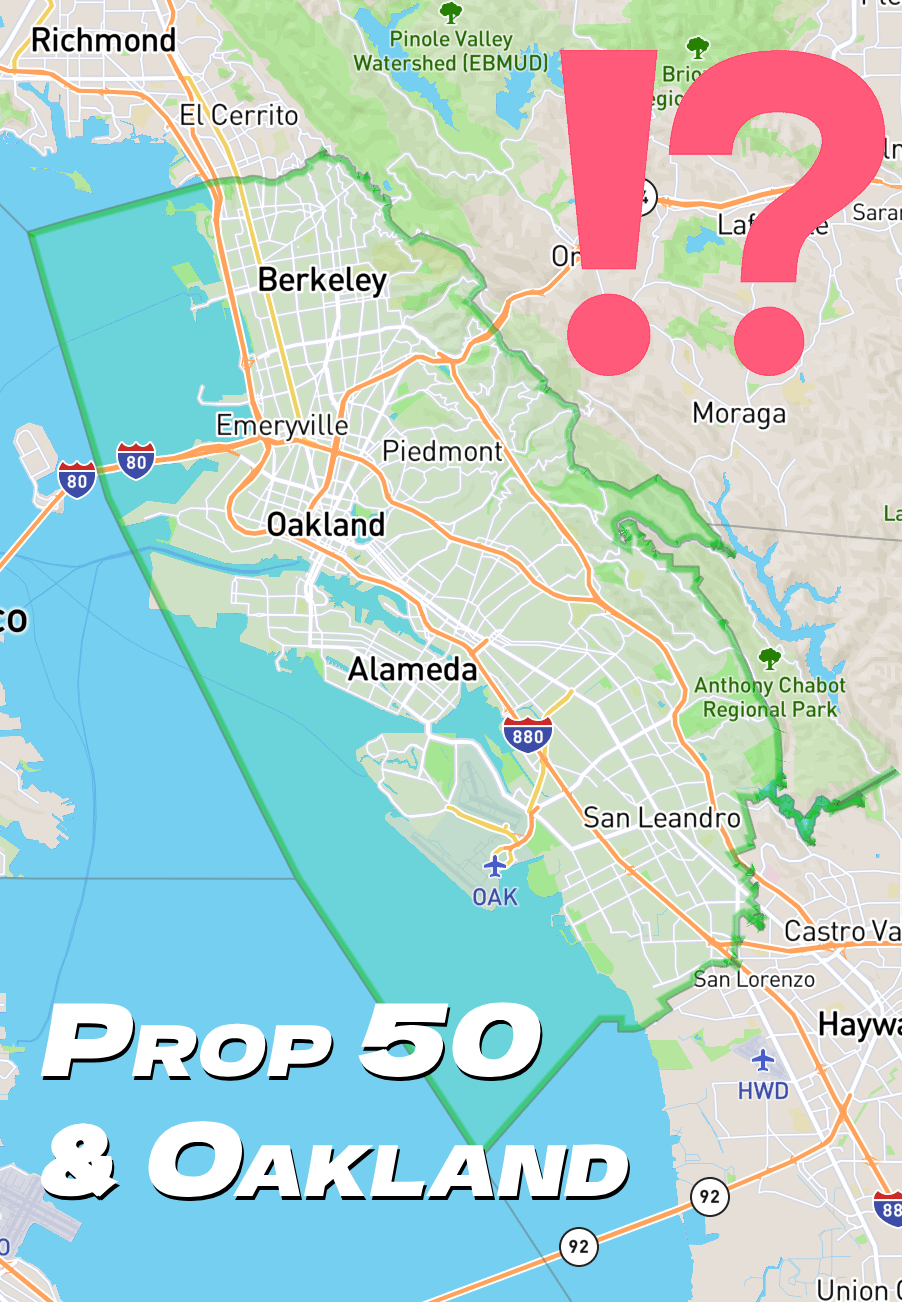
By: The Rethink Oakland Team
- Prop 50 is being sold as a defense of democracy. In reality, it’s another distraction from the chaos and decline California’s leaders refuse to confront.
Politics/Opinion
California loves a good proposition. Every election, Sacramento tells us that one more vote, one more amendment, one more clever workaround will finally make the system work, and all of our problems will finally be solved. This year, that promise comes dressed as Proposition 50, a proposed constitutional amendment that would let California redraw its own congressional maps in “response” to redistricting elsewhere in the country — especially in red states like Texas.
Supporters call it a defense of democracy. But for Oaklanders, it’s another reminder that our leaders care more about fighting Republicans in other states than fixing the decay in their own backyard.
On paper, Proposition 50 sounds technical. In reality, it’s Political Theater. It doesn’t build housing, it doesn’t reduce crime, it doesn’t reopen businesses, and it doesn’t make a single Oaklander safer when they walk home at night. It exists purely so Sacramento can posture against conservatives while pretending to “protect representation.”
Governor Gavin Newsom and his allies are marketing Prop 50 as a noble stand for fairness. In truth, it’s a partisan chess move designed to send a message to Washington — not to the people of California.
Let’s be clear: Oakland’s problems are not the result of gerrymandering in Texas. They’re the result of decades of mismanagement here. Passing Prop 50 won’t clean the streets, reopen corner stores, or make City Hall accountable. But it will let politicians in Sacramento feel righteous while doing nothing for the communities that need them most.
California’s political class has perfected the art of distraction. When the roads are crumbling, they pass resolutions. When the schools underperform, they create task forces. When cities descend into chaos, they form commissions to “study root causes.” And when the public grows restless, they find a new enemy — usually somewhere outside the state.
Prop 50 continues that tradition. It is less about redistricting and more about signaling: “Look at how virtuous we are compared to them.”
But politics built on moral contrast has a cost. While Newsom spends his time positioning California as the anti-Texas, the anti-Florida, the anti-Trump Utopia, ordinary, working class Californians are struggling with record homelessness, rampant crime, and skyrocketing costs.
In Oakland, we see this disconnect up close. It’s not abstract, on the contrary it’s all too real. It’s visibly clear in the boarded-up storefronts, the small businesses leaving for Reno, families moving to Antioch, Tracy, Sacramento or elsewhere in the country just to be able to survive. No proposition about congressional lines will fix that.
Governor Newsom has made a career out of defining himself against Republicans. But leadership is about showing up for your constituents, not for auditioning for cable news segments.
Every time California drifts deeper into dysfunction, the Governor finds another national stage. He calls out “authoritarianism,” “MAGA extremism,” and “right-wing attacks on democracy.” Yet he remains silent when our own streets collapse into lawlessness, disorder, and violence.
Prop 50 is the latest example of this reflex. It lets him posture as the defender of democracy while avoiding accountability for the basic failures of governance: safety, affordability, and transparency.
Oaklanders don’t need a governor who spends his time shadow-boxing with Texas. We need one who can make this state livable again.
Representative Lateefah Simon, Oakland’s recently elected congresswoman, has joined the chorus of support for Prop 50 — another symbolic stand that plays well to Bay Area and Washington donors but says little to the residents she represents.
Simon talks often about justice and inclusion, but rarely about measurable results. Where is her urgency on crime, or on the hollowing out of West Oakland’s small-business corridor? Where is her focus on safety in East Oakland, where shootings are up and police response times stretch ridiculously longer than ever?
When leaders like Simon and Newsom prioritize performance politics, they leave the working class behind. They speak for the narrative, not for the neighborhoods.
Supporters of Prop 50 claim it’s about fairness — making sure California keeps its political weight in Congress as red states redraw maps to their advantage. But fairness in representation means nothing if the people being represented can’t afford to live safely in the state they’re in.
What good is another “balanced” congressional map if half of Oakland feels abandoned? What good is symbolic resistance to gerrymandering if the city itself is ungoverned chaos?
The conservative critique — one Oaklanders increasingly share — is simple: leadership matters more than legislation. You can draw the most equitable districts imaginable, but if the people in charge lack competence and courage, the result will always be failure.
Sacramento doesn’t need more power. It needs serious reform.
To understand Prop 50, you have to understand how California sees itself. For decades, state leaders have built their identity on moral superiority — “We are not them.” Not Texas. Not Florida. Not conservative. Not cruel. Not uneducated. Not unempathetic. Not ignorant.
But in chasing that contrast, California forgot to govern. Compassion without competence is cruelty by another name. “Progressive” leadership that allows cities like Oakland and San Francisco to decay is not moral; it’s neglect dressed in virtue.
Prop 50 is just the next iteration of that mindset. It offers moral validation to the political class while offering nothing to the people cleaning graffiti off their own storefronts.
Opposing Prop 50 isn’t about partisanship; it’s about priorities. Conservatives — and an increasing number of independents — believe that the government should first protect citizens, uphold order, enforce the law and manage local finances before it tries to reshape national politics.
Prop 50 does the opposite. It diverts energy and resources from real problems toward symbolic fights. It is governance as spectacle — another example of Sacramento rewarding itself for its own failures.
If the Governor wants to defend democracy, he can start by defending neighborhoods. If Representative Simon wants to fight for justice, she can start by fighting for order.
Oakland doesn’t need new lines on a map. It needs lines of accountability in leadership.
Oakland’s crises are not caused by who draws the maps in Washington. They are caused by who ignores the people here at home.
Safety is collapsing. Businesses are leaving. Families are stretched to the breaking point. The public knows it. The mainstream press barely covers it. And yet, the same political machine that created these problems keeps finding new ways to change the subject.
Prop 50 is just that — a distraction. A way for California’s ruling class to posture against conservatives and simply anyone who doesn’t subscribe to the Californian way of thinking, meanwhile our own cities crumble.
A pragmatic approach means cutting through the noise. It means demanding policies that fix the basics: safety, affordability, enforcement, and transparency. It means asking the question our leaders refuse to face — who is really being served by these endless symbolic fights?
Because it isn’t us.
The people of Oakland deserve leadership that talks less and delivers more. Leadership that fixes potholes before rewriting constitutions. Leadership that prioritizes working-class residents over political optics.
So when Prop 50 appears on the ballot, don’t be fooled by the marketing. A vote against it is not a vote against democracy. It is a vote for focus, for sanity, for demanding that our leaders remember who they truly serve.
Oakland’s future will not be redrawn by maps. It will be rebuilt by people who still believe in the Town — people willing to hold leadership accountable, even when it’s inconvenient, even when it breaks from the narrative.
Governor Newsom can keep his rivalry with Texas. Representative Simon can keep her headlines. We’ll keep fighting for Oakland.
Because if they won’t put the Town first, we will.
Vote NO on Prop 50.
Rethink Oakland! Rethink!

Federal Enforcement Is Here Because Oakland Leadership Failed
Federal agents leaving will not fix Oakland. New laws will not fix Oakland. Only pressure from residents — sustained and unignorable — will force leadership to act before outsiders have to intervene again. If Oakland wants outsiders gone, Oakland’s leaders must start protecting this community with the same urgency outsiders are showing now — because the people who live here deserve that protection.

BY: THE rethink Oakland Team
- Federal action did not appear out of nowhere — it filled the void left by failed leadership.
News/Opinion
Federal immigration agents are arriving in the Bay Area this week in what multiple reports describe as a major enforcement operation. The immediate response from San Francisco Mayor Daniel Lurie and Oakland Mayor Barbara Lee was predictable — condemn the operation, frame it as an attack on Bay Area values, and insist that federal action is the problem. But the more honest reading is simpler: federal enforcement is stepping in because local leadership has refused to enforce the law themselves.
For years, Oakland and San Francisco officials have built their politics around symbolism instead of outcomes. Public safety was treated as a political liability, not a basic obligation. The federal government does not send hundreds of agents into a region that is functioning — it intervenes where dysfunction has been allowed to deepen.
And while the loudest critics are calling this operation “cruel,” working people in Oakland know a different reality. Residents in East Oakland, West Oakland, and neighborhoods in the city like the Mission are the ones living with the consequences of non-enforcement — not the activists, not the city hall staffers, not the donors, not the commentators. Enforcement is not cruelty. Neglect is. Neglect is what leaves families afraid to walk home, businesses afraid to stay open, and entire neighborhoods left to absorb the fallout of decisions made by leaders who never live with the cost.
Mayor Lurie and Mayor Lee are not angry because peaceful communities are at risk — they are angry because federal intervention exposes their failure. Governor Gavin Newsom joined them in attack mode, calling the federal action part of an “authoritarian playbook” designed to provoke chaos and violence, as though enforcement — not their own inaction — is the source of disorder in California. If they and their predecessors had delivered order, accountability, and safety, there would be no vacuum to fill. Their outrage is not moral — it is defensive.
Critics are already repeating familiar lines — but they collapse under further scrutiny.
“This is intimidation, not safety.”
Fear already exists — but not for offenders. Fear exists for the residents who ride buses at night, who close their shops early because of theft, who hesitate before walking to their car. Enforcement does not create fear — it transfers fear back to those who break the law.
“Federal agents are acting unlawfully.”
Immigration enforcement is federal law, upheld by federal courts. Calling law enforcement “fascism” is not an argument — it is a strategy to delegitimize the rule of law itself.
“This targets immigrants, not criminals.”
Federal operations do not randomly sweep working-class families. They prioritize individuals with criminal records, prior deportation orders, or known gang affiliations. Erasing that distinction is dishonest.
“This will erode community trust.”
Trust was not lost because of enforcement — it was lost because residents watched government excuse chaos for years. People lose trust when leaders refuse to protect them, not when someone finally does.
“This is meant to provoke chaos.” (Governor Newsom’s claim)
The governor warns that enforcement will invite vandalism and violence, but the chaos is already here — under his watch, not Washington’s. It is not enforcement that provokes instability, it is the vacuum created when leaders refuse to enforce the law.
If this operation produces even a fraction of the safety local leaders failed to deliver, it will show that order is still possible when someone is willing to enforce it. That alone is a reason for hope.
But hope is not automatic. A turning point only becomes a turning point if residents refuse to fall back into silence when the headlines fade. If The Town wants better, its people must begin demanding better — publicly, loudly, and without apology.
Federal agents leaving will not fix Oakland. New laws will not fix Oakland. Only pressure from residents — sustained and unignorable — will force leadership to act before outsiders have to intervene again. If Oakland wants outsiders gone, Oakland’s leaders must start protecting this community with the same urgency outsiders are showing now — because the people who live here deserve that protection.
Oakland is not beyond repair — but it will not fix itself. Decline is not destiny unless we agree to live with it. If The Town is going to recover, it will be because its residents finally refused to accept excuses, refused to stay quiet, and forced leadership to deliver results instead of rhetoric.
No more pretending. No more excuses.

A Love Letter to The Town
Rethink Oakland exists for those who already feel this, for the residents who see what is happening, who are done pretending, and who still believe The Town is worth salvaging. This is for the ones who know something is wrong and refuse to silence their own common sense.
By: The Rethink Oakland Team
- Why refusing to stay silent is the only honest form of loyalty.
There is a kind of heartbreak only someone who has lived inside Oakland can understand, the heartbreak of loving a Town that asks so much of its people and gives so little back in return. For most people in this Town, daily life has become an uphill climb.
And the heartbreak is not poetic. You see it in the boarded up windows, the empty storefronts, the security gates around places that used to feel open, and in the silence where there used to be noise. Even the teams that once carried the soul of this Town — the Warriors, the Raiders, and the A’s — chose to leave, not because Oakland stopped caring, but because city leadership stopped leading, leadership that chooses ideology over pragmatism.
Oakland has always had its share of struggle. Poverty, crime, and dysfunction are not new here. But what is different now is that the excuses no longer cover the truth. The consequences are out in the open and ordinary residents live with them every day.
Crime is no longer a headline — it is something we live around.
Homelessness is not a “challenge” — it is collapse in plain view.
Businesses are not quietly relocating — they are leaving to survive.
City leadership is not merely imperfect — it is insulated from consequence.
And worst of all, dissent is not engaged — it is socially excommunicated.
Too many who claim to love this Town are more loyal to a narrative than to the people living with its consequences. Decline is defended not because it protects Oaklanders, but because it protects identities, institutions, and egos built on the illusion that failure is proof of virtue.
I am not writing this out of resentment for Oakland, but because real love does not ignore what is broken. Real love criticizes not to destroy but to repair. To love this Town is to want the people who live here to prosper, not to survive under lowered expectations in the name of someone else’s ideology.
Rethink Oakland exists for those who already feel this, for the residents who see what is happening, who are done pretending, and who still believe The Town is worth salvaging. This is for the ones who know something is wrong and refuse to silence their own common sense.
I refuse to give up on The Town, and I am asking others who feel the same to stop staying silent. If we care about Oakland, we cannot keep pretending. The Town deserves better, and so do the people who call it home.
